Episode Transcript
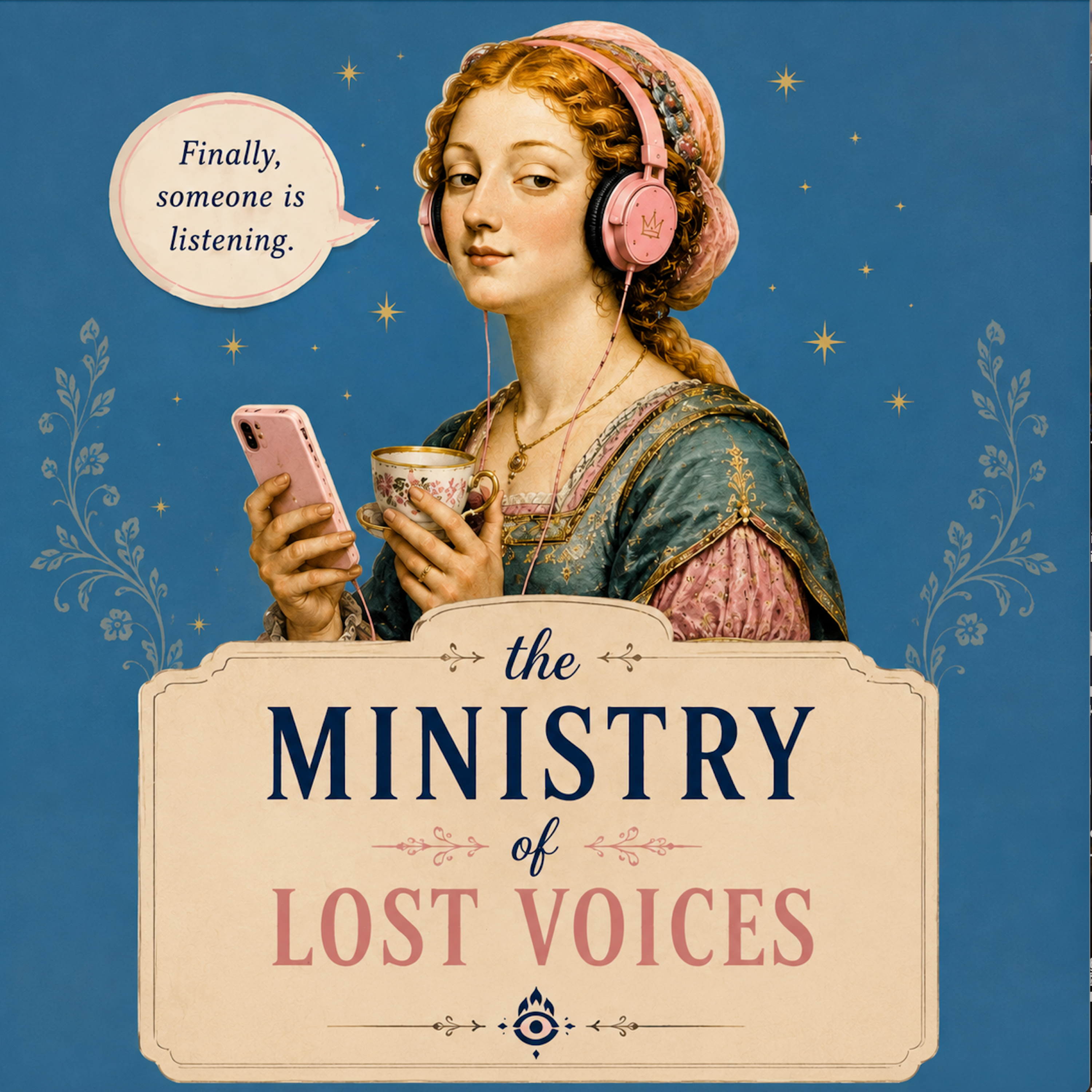
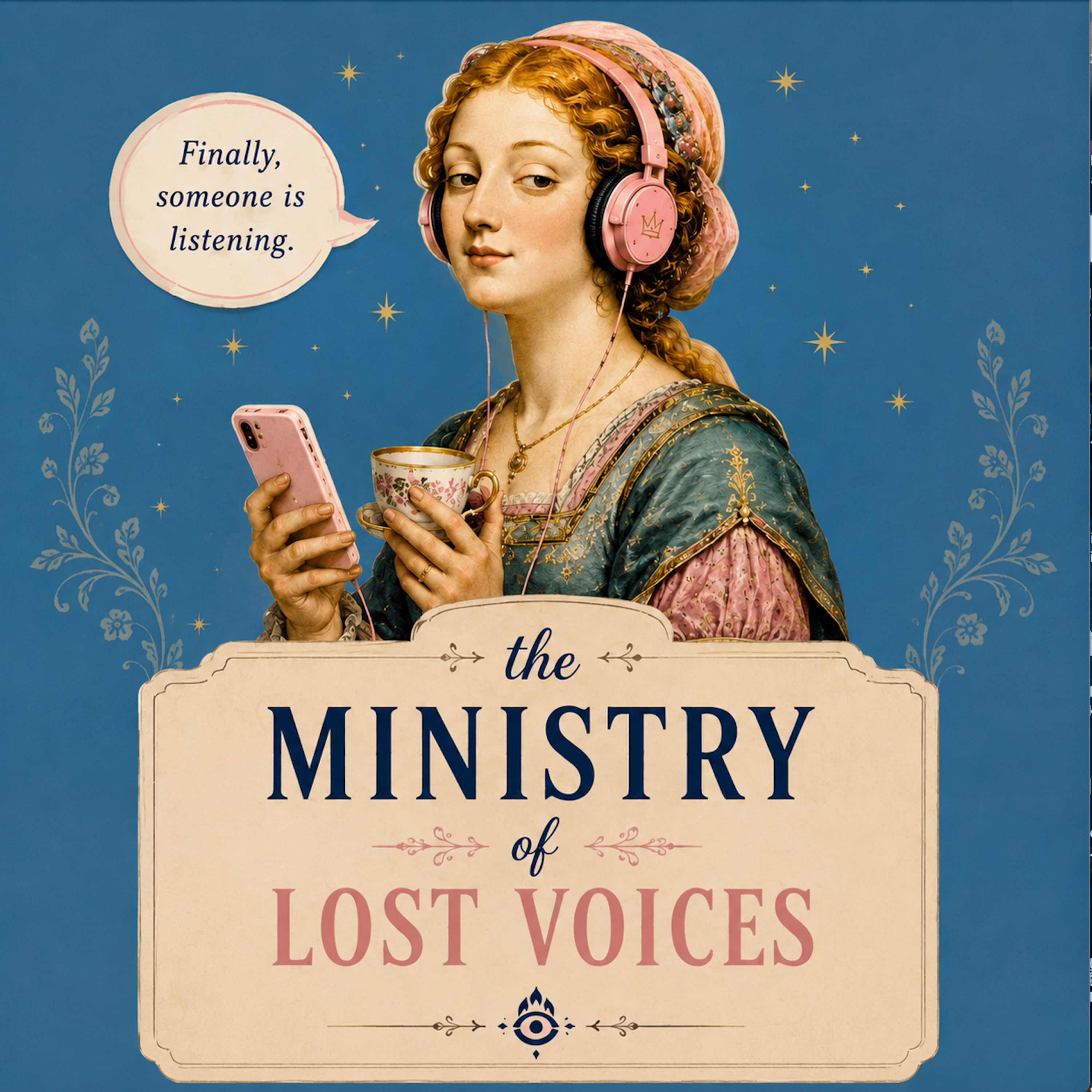
[00:00:02] Speaker A: Welcome to the Ministry of Lost Voices. My name is Valerie, and for reasons that are becoming increasingly difficult to explain, I have apparently become the archivist of the Ministry.
Now, the Ministry began with a fairly simple how many women, somewhere between what they actually did, who they really were, and what we ultimately decided to remember, lost part of their voice along the way? At first I thought I would find only a few, but the longer I searched, the more names appeared. Women who wrote and painted, composed and investigated, traveled to places where, according to the rules of their time, they weren't really supposed to go, developed ideas nobody had asked for, and made much to the administrative irritation of their contemporaries, did not always behave as expected.
Some of the names I knew, others I had never heard of, and perhaps even more interesting were the women whose stories I thought I knew until I looked a little more closely and deeper and discovered how much was hidden behind those few lines in a history book. And so I decided to to build an archive, not just a podcast, but a place where every month we open a file and try to find one woman again. Here in this public podcast, we go looking for her story.
We look at the world she lived in, at what she did and what she left behind, but also at what was lost along the way, misinterpreted, or simply disappeared from view. But the investigation does not end when this episode does, because a ministry also exists. Beyond this podcast, there is a physical archive. Every month, one case file leaves the Ministry and travels miraculously, without the use of any form of time machine, through the ordinary post to our custodians. And I don't know when you last received a letter that wasn't a bill, an advertisement, or. Or some kind of official notice, but I think we urgently need to do something about that, because there is something strangely wonderful about waiting for post you know is coming, but not knowing exactly what will be inside the envelope. There is something about coming home and among everything that still needs to be done, suddenly finding an envelope waiting for you that asks and absolutely nothing of you. You don't receive a notification, no screen, no password, just your name on an envelope. You take it inside and perhaps you make yourself a cup of tea. Or perhaps you don't, and you tear it open immediately, because patience has always been somewhat overrated. And then it begins. A letter, a historical dossier, do documents, cards, reproductions, small pieces of evidence, and strange things. You may not immediately know what to make of traces of a woman and the world she lived in, things you can hold, keep, collect, and discover again later.
And my biggest Pass on. And somewhere among those papers, there is always something that cannot quite be explained. A trail leading to the next vial. Because a custodian doesn't simply receive a story, you become part of the investigation. And there is something else. Inside the Ministry, there is a room that actually, officially does not exist, which is, of course, precisely the kind of room you immediately want to the listening room. There, we attempt something that is historically impossible.
We talk to her. The women you meet here are real. Their lives are real and their stories researched. But when the historical archive stops speaking, the Ministry allows itself to imagine carefully. The conversations in the listening room, therefore never actually took place. The answers are written from what we know about her life, her time, her work, and what she herself left behind.
Her voice is ours. Her ideas are her own. Here in this public podcast, I will open that door for you briefly later on, but not for long. The full conversation remains inside the listening room, exclusively to our custodians. And because voices have unfortunately been particularly good at respecting borders, neither is the Ministry. Every episode is released in both Dutch and English. The story remains the same. The archive remains the same. And, of course, so does the woman we are looking for. Only the language in which we tell her story changes. So whether you enter through the Dutch or the English door, be welcome. You are inside the same archive. And now we really, really, really need to find our first woman. For that, we have to travel back more than 800 years.
Hildegard of Binge. To find Hildegard, we have to travel back to a world that seems to have almost nothing in common with our own. The year is 1098. Books are written by hand. Knowledge travels slowly. Music exists for as long as someone is singing it. And this appears when the final voice falls silent, unless someone takes the trouble to preserve it. For most women, the course of their lives is largely determined by where they are born, the family they belong to, and the decisions other people make on their behalf. And somewhere in that world, a girl is born who will one day write books, compose music, lead religious communities, correspond with some of the most powerful men of her time, and even invent words, because apparently the languages already available to her are not quite enough. But in 1098, nobody knows any of that. Hildegard certainly doesn't. She is still a child when she is placed in the care of Juta von Sponheim at the Benedictine community of D.C. bodenburg. There, her world becomes smaller in miles, but at the same time, infinitely larger in everything that can happen inside her mind. She learns to read and Write, becomes familiar with the psalms and the liturgy and learns to sing. And she sees things. According to the accounts she would later give of her own life, she had been seeing them since childhood. Light images, visions, things other people could not see.
Today, we immediately want an explanation for that. We want to know whether she suffered from migraines, whether it was a neurological phenomenon, religious ecstasy, or something else entirely. But from a distance of more than 800 years, we simply cannot know. What we know is that Hildegard herself believed that what she saw had meaning. And for a long time, very long time, she remained silent about it. That may be the part of her story that fascinates me most, because the woman we remember today, precisely because so much of her voice survived, began as someone who hesitated to use that voice at all. Years become decades. Hildegard remains within the community, learning, observing, singing, and eventually becoming someone the other women look to for leadership. When Jutte dies in 1136, Hildegard is chosen to lead the community herself. She is somewhere in her 30s by then, and almost everything for which we remember her today is still ahead of her. I love that thought, because we have a habit of making people's lives seem logical in retrospect. We look at an extraordinary woman and behave as though her destiny must somehow have been visible from the beginning. But a life never feels like that while you're living it. There is no little sign saying, this is where the part begins that people will remember 900 years from now. And then, when Hildegard is in her 40s, something changes. She no longer remains silent about what she sees. Or perhaps she decides, and maybe that is the wrong word, because in her own account, account it seems less like a choice and more as thought. Silence had simply become impossible. She begins to record her visions and for a moment try to forget what you know about how this story ends. There is no Hildegard Wikipedia. There is no saint, no doctor of the church, no celebrated medieval composer. There is only a woman in the 12th century saying, I have seen something and I want it written down. In my opinion, that is quite a dangerous sentence. Fortunately, she is not entirely alone. The monk Volmer becomes an important collaborator, scribe and confidant, helping her to record her work. And from that work eventually comes Skivias Know the Ways, a vast work in which Hildegard tells her visions and tries to understand what they.
And then something rather unlikely happens. People begin to believe her. More than that, people begin to read her. Her work reaches church authorities and at the Synod of Trier, eventually comes to the attention of Pope Eugenius iii. The woman who spent years hesitating to speak about her visions is now being encouraged by the church to continue writing. Something changes. Not suddenly, not much magically, but her world becomes larger, and so does her voice. Hildegard no longer wants her community to remain dependent on D.C. bodenburg. She wants a place of her own, a monastery of their own, a community under her own leadership. And of course, there is resistance. But Hildegard persists. Around 11:50, her community moves to Rupertsberg near Bingen. Later, another community follows at AI Bingen. And from this point onwards, it becomes almost difficult to keep up with Hildegard, because she doesn't only write about her visions, she composes. And her music sounds different from what you might expect from someone who lived almost nine centuries ago. It can be expansive, soaring, almost restless, as though the human voice is constantly trying to reach somewhere that words alone cannot quite go. Perhaps that is why her music suits her so well. Hildegard seems to be constantly running up against the limits of language. And eventually she does something wonderfully strange. She simply invents new words. Her lingua ignota, literally, her unknown language, contains hundreds of words that she created herself. We also have her literae ignote, an Alphabet of her own that has survived. Why exactly did she do it? We don't really know. And if I'm honest, I rather hope we never solve that completely.
Because there is something irresistible about the idea of a 12th century woman looking at the languages around her and apparently thinking, no, still not enough.
Meanwhile, she keeps writing about God and the cosmos, about the natural world, plants, the human body, illness and health. Not as a modern scientist or physician, because that would mean pulling her out of her own time and forcing her into hours, but as someone convinced that body, nature and spirit are all part of a larger whole. And when you place all these different versions of Hildegard besides one another, something rather curious happens. The mystic doesn't quite fit the composer. The composer doesn't quite fit with the woman writing about plants. The woman living inside the monastery doesn't quite fit with the woman inventing her own language. And none of them quite fits the image we might instinctively have of a medieval nun. Perhaps that is precisely why I find her so fascinating. Hildegard refuses to become a neat category.
At some point during the research for this file, my desk also began to look increasingly less like a desk. There were manuscripts, images, pieces of music, plants, notes, reproductions and fragments of text scattered everywhere. And somewhere among all of them eventually lay the letter that would become part of case LV001. And. And that was when I understood all over again why I wanted the Ministry to have a physical archive. Because when you place all those traces beside one another, the historical figure begins to disappear. And slowly a woman emerges. A woman who spent much of her life within monastery walls, but whose voice would eventually travel far beyond them. Because Hildegard begins writing letters, a great many letters, to people considerably more powerful than she was. Bishops, clergy, noblewomen, rulers. Among the people with whom she corresponds is even Emperor Frederick Barbarossa. And this is where I want to stop for a moment. Because think back to the girl we started with. A child placed within a religious community. A girl who sees things other people, people cannot see. A young woman who remains silent about what is happening inside her mind and place her beside this Hildegard, a woman writing to some of the most powerful people of her time. Somewhere between those two women, something shifts. There is a moment when someone who was once afraid to use her voice discovers that the same voice is worth hearing. And while making this episode, I kept coming back to one what happens to a woman when she finally discovers that her voice carries authority? Because from this point onwards, Hildegard's story becomes even more interesting. She will not only use her voice to write and compose, she will use it against people more powerful than herself. She will involve herself in conflicts. She will admonish people who could have tried to silence her. And towards the very end of her life, she will make one more decision that places her in conflict with the authorities of the very church to which she has devoted her life. But that file we are not going to open completely here. Because to understand why Hildegard did what she did, there is one question I would rather ask her myself. And for that we need to go to another room. The listening room.
What you are about to hear is not an historical interview. This conversation never took place. Hildegard of Bingen died in 1179, which presented even the Ministry with certain logistical difficulties. Her answers have been imagined from the historical records, her surviving work, and what we know about her life. Her voice here is ours. Her history is her own.
Hildegard, you spent so much of your life seeing and experiencing things that other people could not see. Were you ever afraid that no one would believe you?
[00:15:52] Speaker B: Of course there was fear. But there comes a point when remaining silent becomes more frightening than speaking.
[00:15:59] Speaker A: Did you think of yourself as a courageous woman?
[00:16:03] Speaker B: No.
I thought of myself as someone with a responsibility.
Courage is a word other people often use.
Once the danger has passed.
When you are in the middle of it, you rarely think about courage. You think about what needs to be done.
[00:16:19] Speaker A: But you lived in a world in which the space available to women could be very small. You. You wrote, composed, led a community, and eventually founded a monastery of your own. Was there never a moment where you thought, I am not allowed to do this?
[00:16:36] Speaker B: Of course.
But what is allowed and what is possible are not the same thing.
[00:16:42] Speaker A: And if you could ask women today one question,
[00:16:48] Speaker B: I would ask them why.
[00:16:51] Speaker A: Yes, I know. But this is a public department of the Ministry, and apparently there are still, still some rules even here.
The answer to that question and the full conversation with Hildegard is behind the closed door of the listening room.
And this is where you get to decide whether you only want to listen to her story or whether you want to enter the archive yourself. Because when you become a custodian, you don't only gain access to the full conversation.
Something comes to you through the actual post and mail. And perhaps that is my favorite part of this entire project, because we have become a little unaccustomed to waiting for things.
Everything has to become immediately. A book appears on your screen with a simple click. Music begins before you have even properly decided what you want to hear. A message travels to the other side of the world faster than then. You can seal an envelope, and that is wonderful. But somewhere along the way, we have also lost something else.
Longing, anticipation.
The pleasure of knowing that something is on its way, of opening your letterbox and thinking, perhaps today.
And there it is.
An envelope with your name on it. Not because somebody wants something from you, but because somewhere, a story has been waiting for you.
You take the file inside and you don't have to click on anything. You don't have to swipe, you don't have to watch the next video before your attention is pulled somewhere else again. You can simply sit down, open the envelope, feel the paper, smell it, read a letter written especially for you and this file. Looking through the documents, examine the little traces, and at some point find something you cannot quite understand.
Because inside Hildegard's case file is something that does not belong to her. I know it because it has been sitting on my desk for quite some time now. The paper is wrong, the time is wrong, and it absolutely does not belong in a file about a woman from the 12th century. We, this moment have no name, we have no sender. We only have two pieces of information.
A place and a year.
Paris, 1943. And that trail goes to our custodians. First, I'm not going to tell you who is behind it. That would be against all the rules and considerably less fun. If you order case LV001, Hildegard's file will arrive at your home containing her letter. The historical material we have assembled for her traces from her world, access to her full conversation in the listening room, and the first clue leading to the file that will be opened next. You can receive a single file case or remain inside the archive for three, six or 12 months. And the beautiful thing is that you don't simply select the next woman from a catalogue, you discover her. As every good mystery should begin, case LV001 remains open for orders until the 20th of October.
After that the file closes and we begin preparing the post.
And sometime in early November, envelopes will appear on doorsteps where the day before there were none. I hope one of them is yours. And if you know someone who devours books, spends far too long in museums, can never bring herself to throw away beautiful stationery, always wants to know what lies behind a closed door, and would probably become far too excited about mysterious post, you can of course make her a custodian too. Some people are remarkably easy to make happy. You simply have to give them the right envelope. You can find the Ministry of Lost Voices and the archive through through the link accompanying this episode in the show notes. And if for now you would simply like to stay here and listen, you are every bit as welcome. Follow the podcast like the episode, write a review, save this episode, and feel free to send it to someone you think might also belong in a somewhat questionable organized historical ministry. Because there are still many, many friends files waiting and I fear our filing problem is considerably larger than we initially thought.
As for today, we are closing case LV001. Hildegard of Bingen, born around 1098, died in 1179. More than 800 years later, her music is still being sung, her work is still being being read, and we are still trying to understand what she saw when she looked at the world. Perhaps that is ultimately what it means for a voice to truly survive. Not that we preserve every word, but that centuries later, someone is still curious enough to turn the next page. I am Valerie, your archivist. This was the Ministry of Lost Voices. Thank you for listening. But most of all, thank you from Hildegard for not forgetting Her Excellencio Fox.